- 01
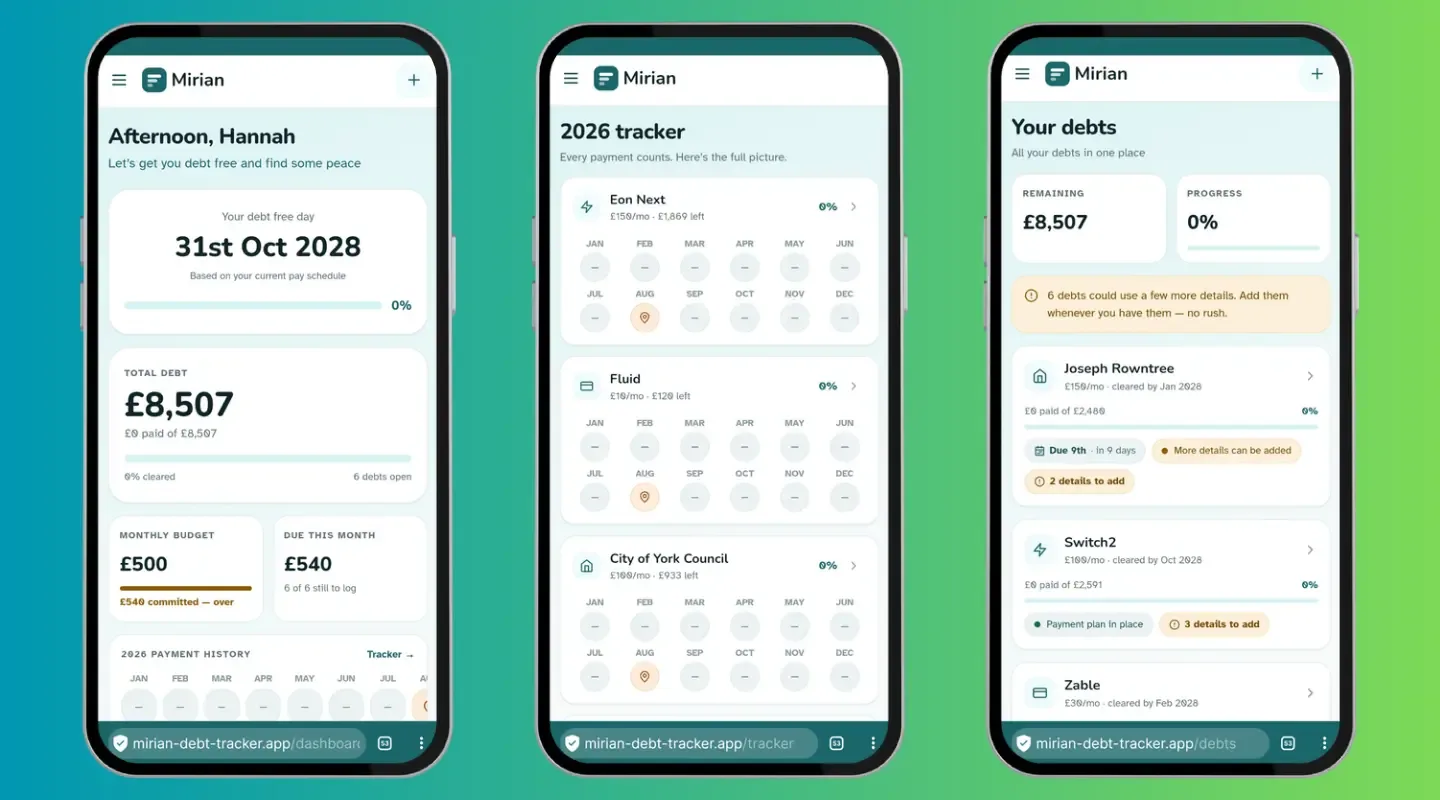
Paid/unpaid became on time, late, short, overpaid. A binary only works if life is binary. This state alone addresses the avoidant persona directly: a short payment now has somewhere to go other than "failure", which is what stops it going unlogged.
- 02
Due dates are tracked per debt, not left to memory. Executive function is what fails first under financial stress, so the app was built to carry that specific load rather than assume it will be remembered, which is also what stops the over-monitoring persona re-checking the same information by hand.
- 03
The balance owed stepped aside for a live debt-free-by date. An open balance only measures distance from a goal, which research on ADHD motivation identifies as demotivating precisely because the win never feels reachable. A date that moves closer with each entry gives a visible, incremental reward instead.
- 04
Arrangements got a third state: in place, needs setting up, awaiting response. Most real debt sits unresolved, not settled, and a system that only offers two states forces a false answer, which is its own small, avoidable source of shame.
- 05
No red, no streaks, no total on the home screen unless asked for. Colour and gamification mechanics common to the category read as pressure, and pressure is exactly what a PDA profile responds to with avoidance rather than compliance.
- 06
Plain-language framing over financial jargon, because jargon adds a second barrier on top of an already anxiety-loaded task.
- 07
Every destructive or overdue state is written as a sentence, never signalled by colour alone, both for colourblind accessibility and because a red badge alone reads as an alarm, where a sentence can carry the same information without the same charge.
- 08
Reduced motion respected throughout, since sudden movement is a common sensory trigger and has no functional purpose here.
- 09
A creditor contact email field sits ready in the debt record, so the hardest single action in debt management, actually contacting a creditor, has its detail in place before the moment someone is ready to use it, rather than adding a lookup step on top of an already difficult decision.